

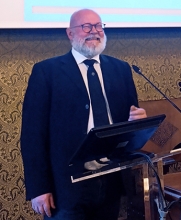
In an era marked by global crises and the erosion of scientific trust, academies must rediscover their original mission: to act as independent actors capable of challenging conventions and steering social progress. This was the central theme of a speech by Sven Lidin, the eminent inorganic chemist and President of the Royal Swedish Academy of Sciences, regarding the vital role of these institutions in Europe.
Lidin proposed a bold metaphor: academies are the “jokers” in the deck of science. While universities are often constrained by political and economic stakeholders who dictate their agendas, academies maintain absolute independence. This autonomy allows them to "change the rules of the game" and focus exclusively on scientific excellence. “The joker represents only 2% of the deck, but it can transform into any card and make crucial decisions about which direction to take,” the Professor explained.
Academies, originally established to bring scholars together and challenge the "eternal truths" taught in universities, now face new forms of pressure. Lidin warned that academic freedom is threatened when science is subjugated to ideologies or when the value of basic research is questioned—often mistakenly dismissed as "useless." He also stressed the importance of defending the social sciences and humanities, noting that these fields are often where the first signs of intellectual oppression emerge.
As a representative of the institution that awards the Nobel Prize, Professor Lidin reflected on the award's power as a beacon for society. The prize is not only a tribute to individual excellence but also a tool to demonstrate how science has radically improved human life, from vaccines to technology. Citing the communication failures during the COVID-19 pandemic, he urged the scientific community to be more effective in conveying facts: “Science does not possess absolute truth, but it is the most powerful method we have for approaching it.”
The President outlined several key priorities for the future:
Publication Reform: Combating the current redundant system to shift the focus back toward meaningful, high-quality contributions.
Empowering Young Researchers: Supporting the next generation through programs like the Wallenberg Academy Fellows, which promote excellence and the integration of international scholars.
Strengthening European Collaboration: Enhancing cooperation between European academies (via networks such as SAPEA) to ensure that policy decisions, particularly regarding climate change, are based on facts rather than ideology.
“We have a responsibility not to remain silent,” Sven Lidin concluded. Academies must serve a dual purpose: acting as “ivory towers” that safeguard scientific values, while simultaneously serving as pillars of society capable of engaging in public discourse and advancing the collective good of humanity.