

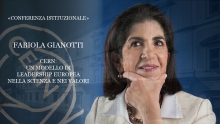
In the frame of a series of lectures on Europe, a meeting was held at the Accademia Nazionale dei Lincei with Fabiola Gianotti, a member of the Academy and former Director-General of CERN, who spoke about the role of the Geneva-based laboratory as a model of excellence and scientific leadership. Founded in the early 1950s amid the ruins of World War II, CERN was born out of a vision to restore the continent’s scientific leadership by promoting peaceful collaboration through the universal language of knowledge. Today, with 27 member states and a community of over 17,000 people from 110 different countries, the organization is an institution that, while operating on a global scale, maintains a deeply European identity. Fabiola Gianotti emphasized the center’s strategic importance in the current geopolitical context, describing it as a model of cohesion at a time when Europe is called upon to address the challenges of fragmentation and technological dependence. This leadership extends beyond research into the fundamental building blocks of matter to encompass an innovative capacity that positions CERN as a cutting-edge technological driver. The laboratory acts as a research partner for industry, transferring expertise in strategic sectors such as superconducting magnets, cryogenics, artificial intelligence, and advanced computing, thereby supporting the continent’s competitiveness with annual investments exceeding half a billion Swiss francs. Another key pillar is the training of the next generation, with approximately 5,000 young talents trained each year in STEM fields, who bring a collaborative mindset and high-level technical skills to society. Our commitment to Open Science also ensures that every innovation is made available to humanity free of charge, in keeping with the spirit of the 1953 Founding Convention. As we look toward the frontiers of the future, the challenge now shifts to exploring the dark universe, which makes up 95% of the cosmos. To address these questions, CERN is conducting a feasibility study for the Future Circular Collider, a new 91-kilometer accelerator designed to push beyond the current limits of research. As also highlighted in the recent Draghi report on competitiveness, ensuring CERN’s leadership in cutting-edge research remains a priority for securing Europe an active role in the technological challenges of the coming century, and serves as a shining example for the establishment of a European Centre for Artificial Intelligence. The bond between Italy and CERN, rooted in the contributions of figures such as Edoardo Amaldi, Carlo Rubbia, and Luciano Maiani, continues today through this path of research and international cooperation.